Scattering Bias-Tuning
This document explains how the bias-tuning mechanism works in the scattering loop implemented in scattering_flow_control in scattering.cu. The goal of this mechanism is to dynamically adjust the scattering bias so that the number of scattered photons remains close to a desired target ratio.
Motivation
In Monte Carlo radiative transfer simulations, scattering events may produce too many or too few photons depending on the bias parameter
If too many photons are produced:
memory usage increases
computational cost grows quickly
If too few photons are produced:
statistical noise increases
scattering events are poorly sampled
To control this, the code dynamically adjusts a bias-tuning parameter (biasguess) to maintain a desired ratio between:
where:
\(N_{\rm scat}\) is the number of scattered photons
\(N_{\rm in}\) is the number of incoming photons
Parameters
params.biasguess
Scaling factor that modifies the scattering probability.
params.targetRatio
Desired ratio between scattered photons and incoming photons. For example, a target ratio of 0.5 means the algorithm attempts to produce roughly 0.5 scattered photons per incoming photon. In this algorithm, we accept the tuning if it falls within ±20% tolerance.
Overview of the Algorithm
For each scattering round n:
The photons from the previous round are copied into
CurrentLayerScattering.A kernel (
track_scat) is launched to simulate scattering.The number of produced scattered photons is measured.
The ratio between scattered and incoming photons is computed.
If the ratio is outside the allowed interval, the bias is adjusted and the photons are re-tracked.
This process repeats until:
The ratio falls within the acceptable range, or
The maximum number of bias-tuning iterations is reached.
The relative improvement in the ratio is less than 10%, indicating that further tuning may not be effective.
Note
In the implementation, each scattering layer has its own bias-tuning parameter. The values are stored on the device in an array so that every scattering round \(n\) uses its own value \(\mathrm{b}_n\). This allows the algorithm to adapt the scattering bias independently for each layer, since the probability of scattering and the number of generated photons can vary significantly between different layers.
Improvement
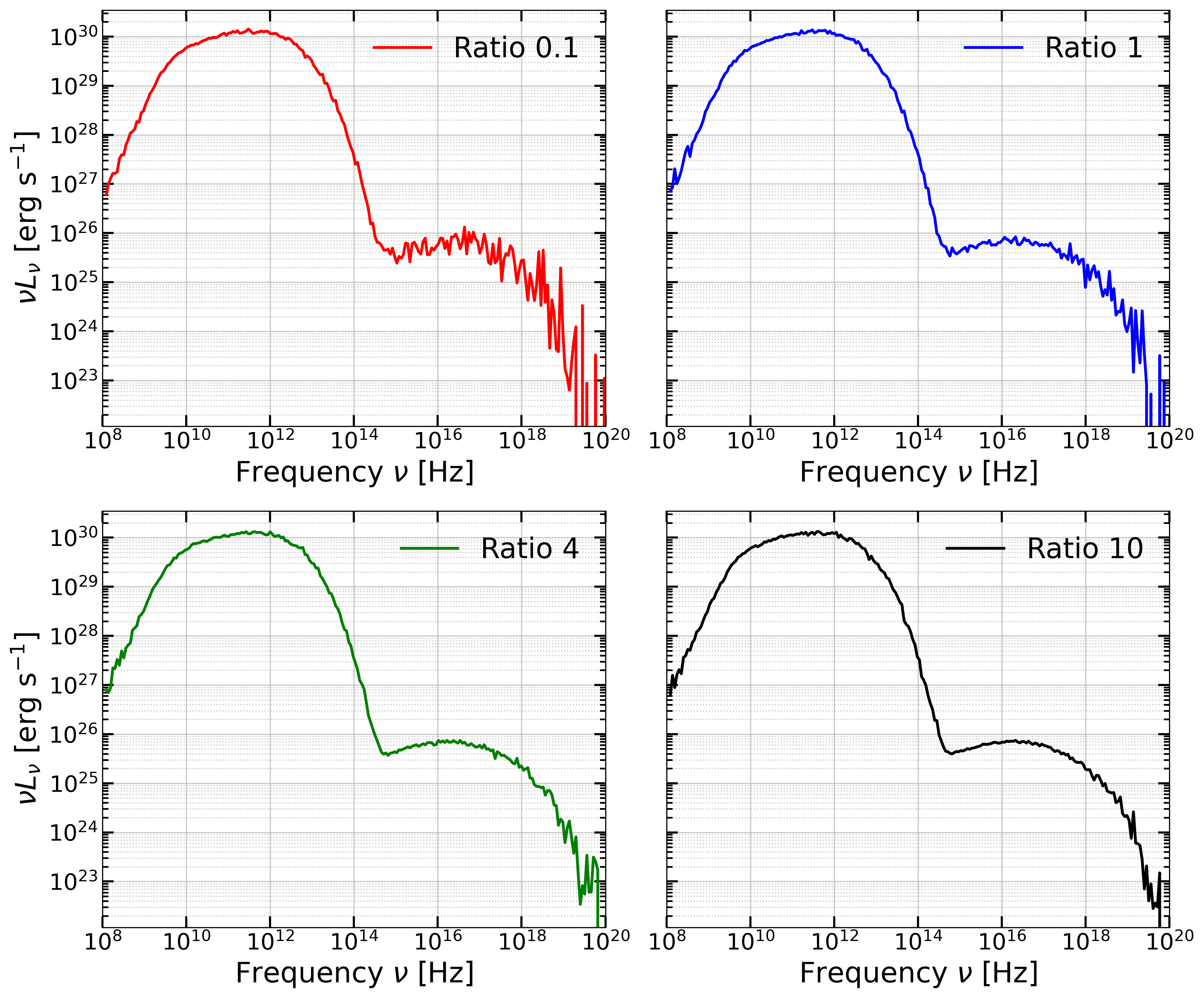
Expected Result: The resulting spectrum showing the \(\rm Ratio = 0.1, 1, 4, 10\) showing improvement to the first scattering layer.
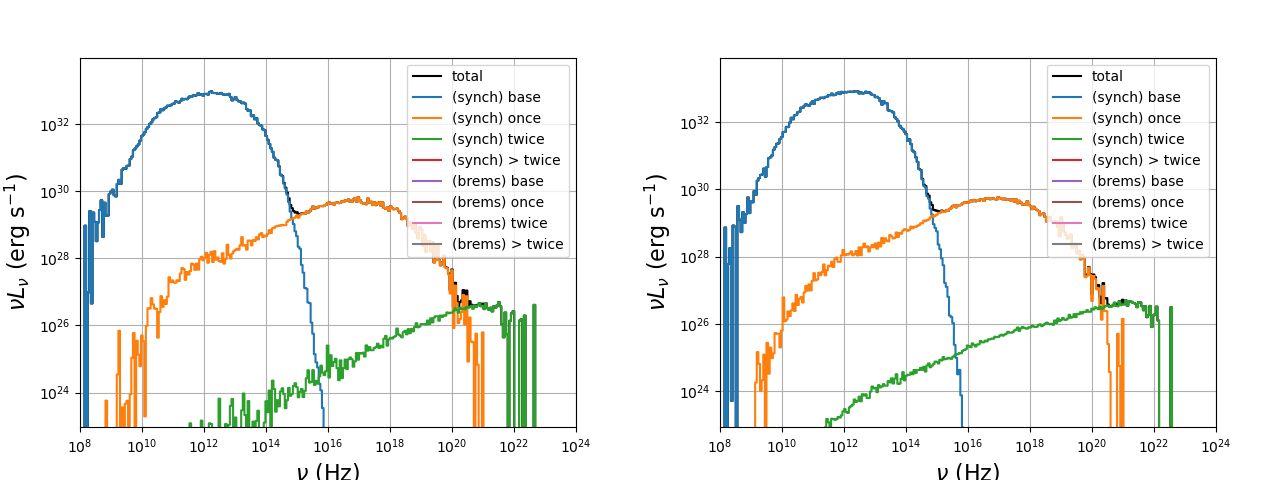
Expected Result: Comparison between the spectrum without bias tuning (top) and with bias tuning (bottom) showcasing individual layers.
Usage Observations
The following considerations may help ensure stability when using the bias-tuning algorithm in GPUmonty.
Target Ratio and Memory Limits
The target ratio can exceed the value of SCATTERINGS_PER_PHOTON defined in config.h. Formerly, If this limit was exceeded, GPUmonty would target more scattering events than the GPU memory could handle, which would lead to out-of-memory errors. Now, it will dynamically allocate max(2 * TargetRatio, SCATTERINGS_PER_PHOTON) scattering events per photon, which allows it to handle target ratios bigger than SCATTERINGS_PER_PHOTON without crashing.
Very Optically Thin Plasmas
If the plasma is too optically thin (for example when M_unit is very small), the algorithm may struggle to produce scattering events even when using a large biasguess or target ratio.
Each scattering event reduces the weight of the superphotons, which may eventually make their contribution to the spectrum negligible. To prevent meaningless scatterings, the code enforces the condition:
weight_scat > WEIGHT_MIN
As a result, simply increasing biasguess will not always increase the number of useful scattering events.
If the relative improvement in the scattering ratio is less than 10%, the tuning algorithm will stop adjusting the bias and accept the current value.
Invalid Memory Errors During Tracking
If invalid memory access errors occur during the photon tracking phase, this usually indicates that the scattering configuration is too aggressive.
Possible solutions include:
Reducing
biasguess.Increasing
SCATTERINGS_PER_PHOTONinconfig.h.
Increasing SCATTERINGS_PER_PHOTON allows the code to allocate memory for a larger number of potential scattering events per photon.